
ECP Prevention Therapy
Prevention of Axial Myopia – A Real Possibility
This page is for Eye Care Professionals Viewing Only. See the reference list further below for additional information.
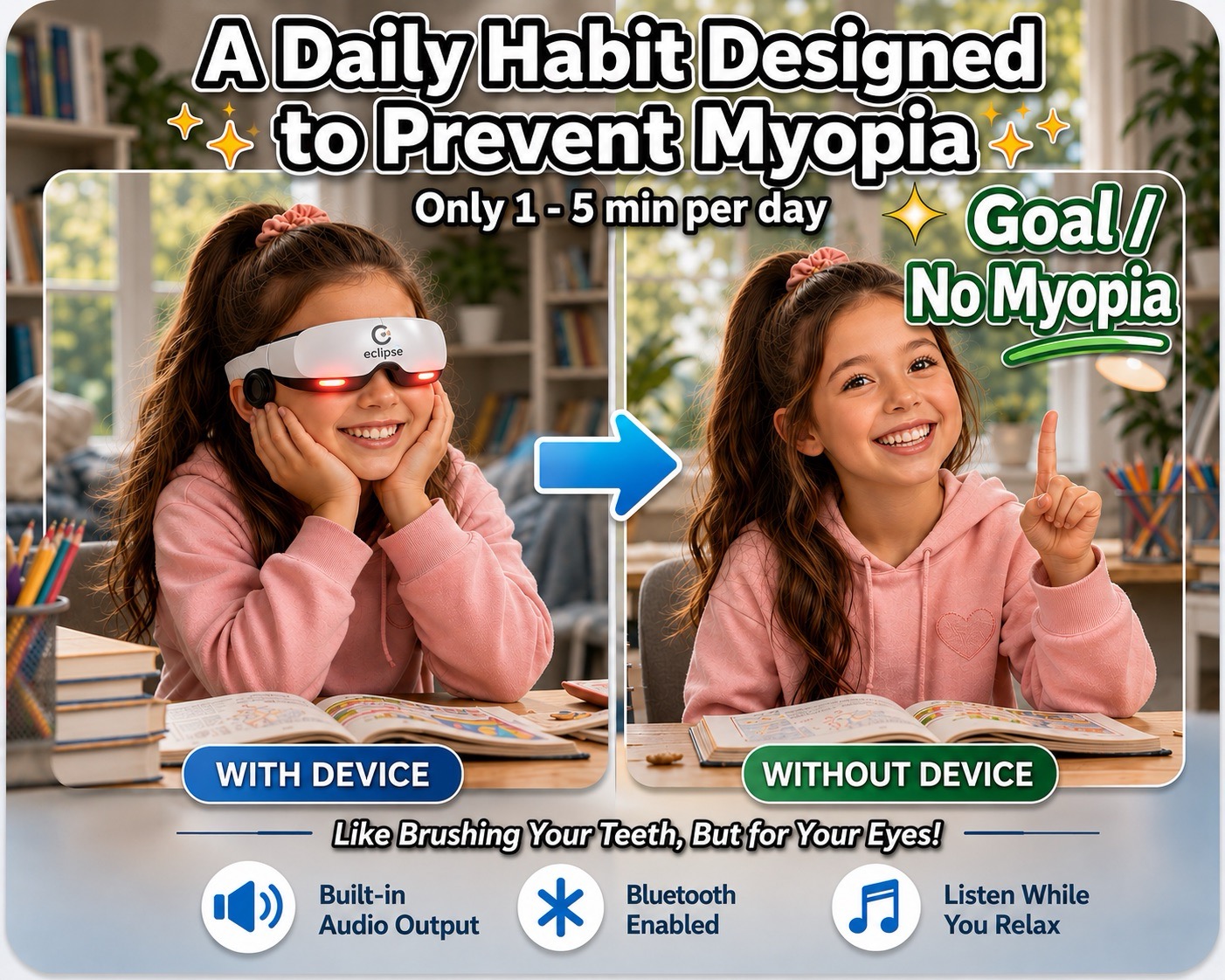
Under Development / Not for Sale / Will Need FDA Approval / Tabletop Unit to be Developed first.
US and Foreign Patents Granted and Pending
References
-
- Foster, R.G., Fundamentals of circadian entrainment by light, Lighting Res. Technol. 2021; 53: 377–393.
- Li, C-Y. et al., The Light–Eye–Brain Axis: Neurobiological Links Between Mood Disorders and Myopia – A Narrative Review, Ophthalmol Ther (2026) 15:901–924.
- Moore-Ede, M. et al., Lights should support circadian rhythms: evidence-based scientific consensus. Photonics 2023, 4:1272934.
- Foster, R. G. et al., Circadian Photoentrainment in Mice and Humans, Biology 2020, 9, 180.
- Vilotijevic, A. et al., Functional benefits of cognitively driven pupil-size changes, WIREs Cognitive Science, 2023, e1672.
- Ketema, P. et al., The role of retinal photoreceptors in the regulation of circadian rhythms, Rev Endocr Metab Disord. 2009; 10(4): 271–278
- Zelle, A.J. et al., The Circadian Response of Intrinsically Photosensitive Retinal Ganglion Cells, PLoS One, 2011, Vol 6, Issue 3, e17860.
- Markwell, E. et al., Intrinsically photosensitive melanopsin retinal ganglion cell contributions to the pupillary light reflex and circadian rhythm, Clin Exp Optom. 2010; 93(3):137-49.
- Fasciani, I. et al., A New Threat to Dopamine Neurons: The Downside of Artificial Light, Neuroscience 432 (2020) 216–228.
- Li, D. et al., Is Spending More Time Outdoors Able to Prevent and Control Myopia in Children and Adolescents? A Meta-Analysis, Ophthalmic Res. 2024; 67(1):393-404.
- Xiong, S. et al., Time spent in outdoor activities in relation to myopia prevention and control: a meta-analysis and systematic review, Acta Ophthalmol. 2017; 95(6):551-566.
- He, X. et al., Time Outdoors in Reducing Myopia A School-Based Cluster Randomized Trial with Objective Monitoring of Outdoor Time and Light Intensity, Ophthalmology, Vol 129, 11, 2022, 1245.
- Valter, K. et al., Photobiomodulation use in ophthalmology – an overview of translational research from bench to bedside. Ophthalmol. 2024, 4:1388602.
- Dompe, C. et al., Photobiomodulation – Underlying Mechanism and Clinical Applications, Clin. Med. 2020, 9, 1724.
- Cannas, C. et al., Current Applications and Future Perspectives of Photobiomodulation in Ocular Diseases: A Narrative Review. Sci. 2024, 14, 2623.
- Fantaguzzi, F. et al., Shedding Light on Photobiomodulation Therapy for Age-Related Macular Degeneration: A Narrative Review, Ophthalmol Ther (2023) 12:2903–2915.
- Quirk, B. et al., What Lies at the Heart of Photobiomodulation: Light, Cytochrome C Oxidase, and Nitric Oxide – Review of the Evidence, Photobiomodulation, Photomedicine, and Laser Surgery, 38, 9, 2020 Pp. 527–530
- Quint, W.H. et al., Exposure to cyan or red light inhibits the axial growth of zebrafish eyes, Experimental Eye Research 230 (2023) 109437.
- Maruani, J. et al., Bright Light as a Personalized Precision Treatment of Mood Disorders. Psychiatry 2019, 10:85.
- Rojas, C.R. et al, Low-level light therapy of the eye and brain, Eye and Brain 2011:3 49–67.
- Zhang, P., et al., Light Signaling and Myopia Development: A Review, Ophthalmol Ther (2022) 11:939–957
- Munteanu, T. et al., Light-dependent pathways for dopaminergic amacrine cell development and function, eLife 2018;7:e39866.
- Perez-Fernandez et al., Rod Photoreceptor Activation Alone Defines the Release of Dopamine in the Retina, Current Biology, 2019, 29, 763–774.
- Carpena-Torres, C. et al., Increased ocular dopamine levels in rabbits after blue light stimulation of the optic nerve head, Experimental Eye Research 234 (2023) 109604.
- Zhu, Q. et al., Near Infrared (NIR) Light Therapy of Eye Diseases: A Review, Int J Med Sci 2021; 18(1):109-119